
How to measure engine RPM with your phone
No tachometer? No problem. Your phone's microphone can hear every power stroke. Here's how to get a rock-solid reading in under a minute.
⏱️ Open the RPM meter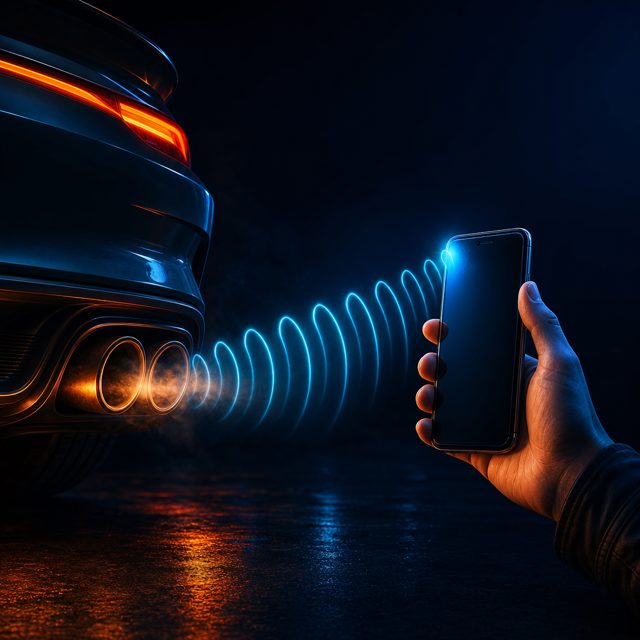
Position your phone near the sound
Hold your phone 20–50 cm (8–20 inches) from the exhaust tip or open engine bay. Most phones have their main microphone on the bottom edge, so point that end at the sound.
Stay to the side of the exhaust stream — the hot gas blowing over the mic sounds like wind and hides the engine pulses.

Choose the engine type and cylinders
Tap 4-Stroke for cars, trucks and most motorcycles, 2-Stroke for chainsaws, dirt bikes and leaf blowers, Rotary for Wankel engines, Blades for fans and drones, or Custom for anything else.
Set the number of cylinders, rotors or blades. This is what turns the sound frequency into RPM, so it matters!

Tap START and hold steady
Allow microphone access when your browser asks. Within a second the gauge locks on and the live RPM graph and sound spectrum start moving.
Rev the engine slowly and watch the needle follow. The Lock bar shows how confident the detector is.

Press STOP to save and compare
When you press STOP, your session's average, minimum, peak and final RPM are saved with the date, time and your approximate city.
You'll instantly see how your peak compares with everyone else's, and your session appears live on the community board.
The RPM formula
An engine's sound is dominated by its firing frequency — how many power pulses happen each second. Knowing the engine type and cylinder count, frequency converts directly to RPM:
RPM = Hz × 120 ÷ cylindersEach cylinder fires every 2nd revolutionRPM = Hz × 60 ÷ cylindersEach cylinder fires every revolutionRPM = Hz × 60 ÷ rotorsOne pulse per rotor per shaft turnRPM = Hz × 60 ÷ bladesBlade-pass frequencyExample: a 4-cylinder car idling at 800 RPM fires 800 × 4 ÷ 120 = 26.7 times a second. At 3,000 RPM that's 100 Hz — the deep hum you hear.
Which mode should I pick?
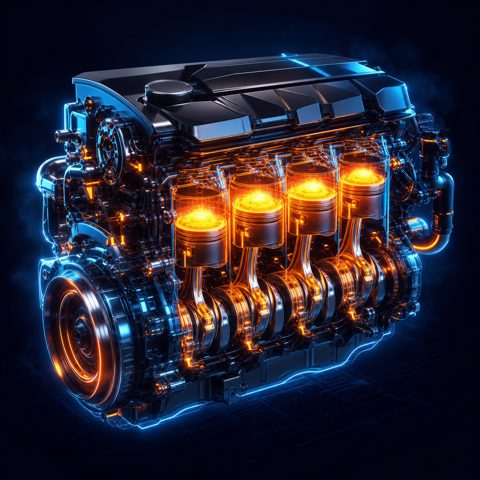
🚗 4-Stroke Engine
Cars, trucks, most motorcycles, lawn mowers. Each cylinder fires once every two revolutions.
Typical range 500–8,000 RPM · e.g. Car, truck, motorcycle, generator
🏍️ 2-Stroke Engine
Dirt bikes, chainsaws, leaf blowers, outboards, RC nitro. Each cylinder fires every revolution.
Typical range 1,500–14,000 RPM · e.g. Dirt bike, chainsaw, leaf blower, scooter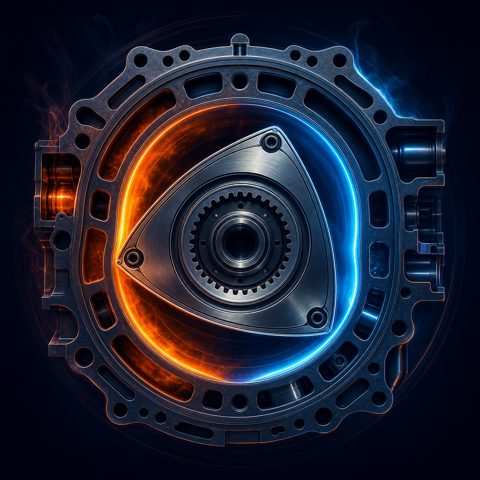
🔺 Rotary (Wankel)
Mazda RX-7 / RX-8 and other Wankel engines. One power pulse per rotor per shaft revolution.
Typical range 600–10,000 RPM · e.g. RX-7, RX-8, rotary aircraft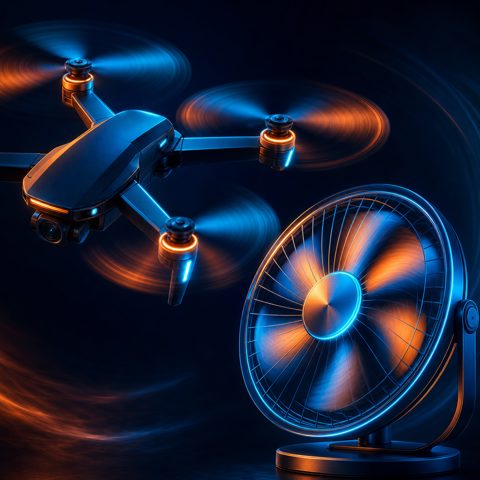
🚁 Fan / Propeller / Drone
Drones, RC planes, desk fans, PC fans, boat props. Measures the blade-pass hum.
Typical range 300–30,000 RPM · e.g. Drone, desk fan, PC fan, propeller
🔁 Anything That Repeats
Drills, lathes, motors, turntables, washing machines, even a playing card in bike spokes. Set how many clicks each turn makes.
Typical range 30–30,000 RPM · e.g. Drill, motor, spoke card, washing machineTips for the most accurate reading
- Turn off the radio and A/C fan. Other steady sounds can confuse the detector.
- Stay out of the wind. Wind noise on the mic is the #1 cause of bad readings.
- Watch the Lock bar. When it's above half and the status says Locked on, the number is trustworthy.
- Use the Idle range for idle checks. A narrow range prevents half/double readings.
- V-twins and odd-fire engines (Harley-Davidson, some V6s) fire unevenly — if readings look half, try doubling the cylinder count.
- Check the spectrum. The orange line should sit on the tallest repeating peak; the fainter lines should line up with its harmonics.
Troubleshooting
How does a phone measure engine RPM?
Every time a cylinder fires it makes a pressure pulse you can hear. RPM Counter listens with your microphone, finds that firing frequency in the sound spectrum and converts it: RPM = frequency × 120 ÷ cylinders for a 4-stroke engine, or frequency × 60 ÷ cylinders for a 2-stroke.
Is the RPM counter free?
Yes. RPM Counter is 100% free, runs in your browser and needs no app install or account.
How accurate is it?
With a clear, steady engine sound most readings land within 1–3% of a real tachometer. Accuracy drops with loud wind, other engines nearby or very low idle on phones whose microphones filter out deep bass.
Why is my reading half or double the real RPM?
Some engines produce strong sounds at half or twice the firing frequency. Double-check the cylinder count, then narrow the expected range (Idle or Custom) so the detector searches the right band.
Does it work for motorcycles, chainsaws and drones?
Yes. Use 4-stroke for most motorcycles, 2-stroke for chainsaws, dirt bikes and leaf blowers, Blades for drones and fans, and Custom for anything else that makes a repeating sound.
Is my audio recorded or uploaded?
No. All sound processing happens on your device. Only the final numbers (RPM, duration, settings) are saved, along with your approximate city from your IP address — never the raw IP or audio.
Where should I hold my phone?
About 20–50 cm from the exhaust tip or engine bay, out of the exhaust stream. Point the bottom microphone toward the sound and keep your hand still.
Give it a try
Grab your phone, pop the hood and see what your engine is really doing.
Start measuring